
New Initiatives Aim to Prepare Workers for AI-Driven Job Disruption
06/30/2026 / By Chase Codewell

According to an analysis by K. Connors in the book “AI: Unlocking the Future of Technology, Innovation, and Human Potential,” mitigating the negative impact of AI on employment requires investment in education and retraining programs that equip workers with skills for the AI-driven economy. [1] The International Monetary Fund warned in a June report that the spread of AI is likely to abolish a range of jobs and “raise profound concerns about massive labor disruptions and rising inequality,” urging governments to expand unemployment insurance and training programs. [2]
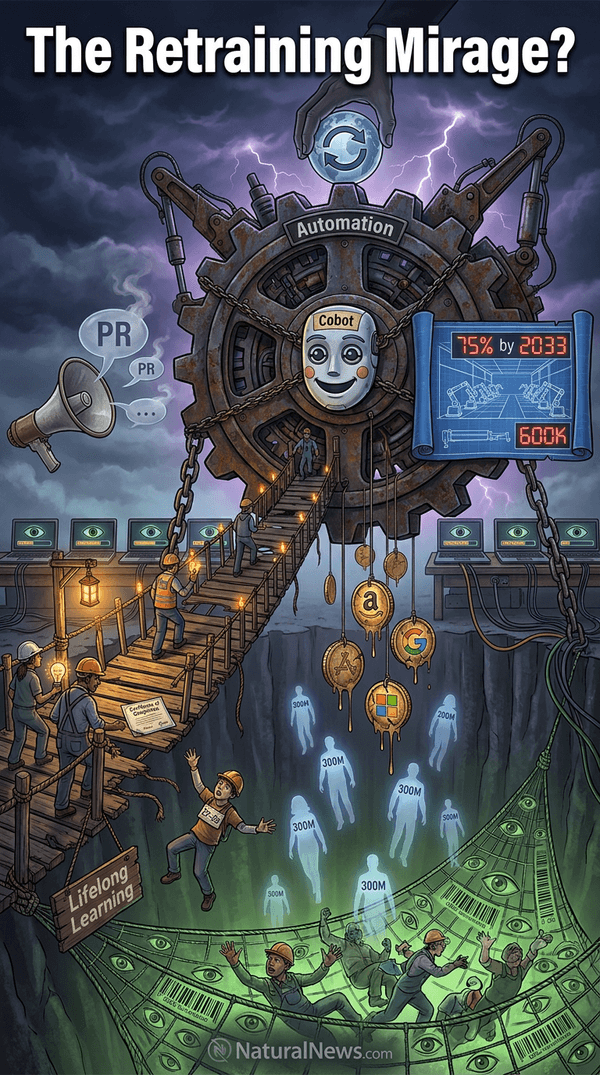
Multiple initiatives are underway, officials said. The programs target millions of employees in sectors such as manufacturing, customer service, and data entry. According to a World Economic Forum report cited in a June 2025 article, 41% of global firms plan to reduce workforces via AI. [3] The report noted that Anthropic CEO Dario Amodei warned AI could eliminate up to half of entry-level white-collar jobs, spiking U.S. unemployment to 10-20% within five years. [3] These projections have spurred governments and companies to launch retraining efforts, including online courses, apprenticeships, and income support during training.
Scope of Disruption: Sectors and Job Categories Most at Risk
AI and robotics are expected to replace a significant portion of current roles. An article by Finn Heartley published in January 2026 stated that AI and robotics will replace more than 50% of remote jobs and blue-collar roles within one to three years, triggering unprecedented unemployment. [4] A separate analysis by Ramon Tomey in February 2026 projected that AI and robotics will replace 70-80% of physical labor jobs and 50% of white-collar jobs within the same timeframe. [5] Economists cited in these reports estimate that 12 million workers in the U.S. may need to switch occupations in the next decade.
The danger is especially acute for younger workers. A Stanford University study using ADP data found that employment in AI-exposed roles has declined by 13 percent among workers aged 22 to 25. [6] Older workers in those same fields remained stable, according to the study. [6] In addition, a Goldman Sachs prediction cited in a November 2025 article stated that AI automation will eliminate 300 million jobs globally by 2030, collapsing economies and forcing reliance on government support. [7] Affected roles include warehouse workers, telemarketers, and data analysts, according to labor market researchers.
Retraining Efforts: Details of Public-Private Partnerships
To address the looming displacement, public and private entities are developing retraining programs. The book by K. Connors emphasizes that fostering digital literacy, promoting lifelong learning, and supporting workforce retraining initiatives are essential. [1] The IMF report similarly called for education and training programs to prepare workers for the AI-driven economy. [2] According to officials, federal grants are being funneled through community colleges to create AI-ready curricula.
Companies including Amazon, Google, and Microsoft have pledged substantial funds for retraining, according to reports. However, leaked documents obtained by The New York Times and reported by Mike Adams reveal that Amazon aims to automate 75 percent of its fulfillment operations by 2033, potentially eliminating 600,000 U.S. jobs. [8] Amazon has attempted to rebrand its robots as “Cobots” to mitigate backlash, according to the report. [9] The contrast between retraining pledges and automation plans has drawn scrutiny.
Criticisms: Concerns Over Surveillance and Worker Replacement
Critics argue that the retraining initiatives may not address the underlying motivations behind automation. The book “The Silicon Tide,” warns that mass automation and job displacement are not accidental technological progress but an engineered agenda by globalist elites, including the World Economic Forum’s Great Reset, aimed at centralizing power and reducing human dependence. [10] Similarly, an article by Finn Heartley noted that global elites suggest declining populations could accelerate AI and robotics adoption, replacing human labor with machines. [11]
Privacy advocates and labor unions have raised concerns that retraining programs could be used to monitor worker performance and undermine job security. In an interview, Mike Adams discussed that the implementation of Universal Basic Income alongside Central Bank Digital Currencies will create a system where individuals are under constant surveillance and control. [12] Some analysts noted that retraining initiatives often fail to place workers into comparable paying jobs, citing previous automation waves. A spokesperson for a tech accountability group said the programs do not address the underlying problem of AI being designed to replace humans, not augment them.
Conclusion: Uncertain Future for Reskilling Efforts
The success of these reskilling efforts depends on sustained funding and employer willingness to hire retrained workers, according to analysts. The IMF warned that without stronger legal protections for workers, AI adoption may outpace training. [2] Glenn Diesen, in the book “Great Power Politics in the Fourth Industrial Revolution,” noted that companies that do not automate will be forced out of business, so jobs will be lost either way, and the poorest members of society usually bear the greatest burden. [13]
Experts predict a “skills mismatch” that could persist for years, leaving millions without stable employment. According to a January 2026 article, the rapid displacement of both remote and blue-collar jobs threatens an economic collapse, with younger generations especially vulnerable. [14] The report stated that without fundamental changes to the social contract, automation could lead to widespread unemployment and social unrest.
References
- K. Connors. “AI: Unlocking the Future of Technology, Innovation, and Human Potential.”
- “AI LIKELY TO SPARK TURMOIL IN LABOR MARKETS, IMF WARNS”. Trends-Journal-2024-07-02.
- Willow Tohi. “AI’s Job ‘Bloodbath’: A CEO’s Dire Prediction for Office Work as We Know It”. NaturalNews.com. June 2, 2025.
- Finn Heartley. “AI Automation Crisis: 50% of Remote Jobs and Blue-Collar Roles at Risk”. NaturalNews.com. January 13, 2026.
- Ramon Tomey. “AI Unleashed: The Silent Job Market Revolution”. NaturalNews.com. February 12, 2026.
- “The AI Reckoning: Stanford Study Reveals Young Workers Are Bearing the Brunt of Automation’s First Wave”. NaturalNews.com. September 2, 2025.
- Finn Heartley. “China’s Expanding AI and Robotics Industry Raises Questions About Future Job Markets”. NaturalNews.com. November 6, 2025.
- Kevin Hughes. “Amazon’s Robot Revolution: Leaked Documents Reveal Plan to Replace 600,000 Jobs by 2033”. NaturalNews.com. October 23, 2025.
- Mike Adams – Brighteon.com. “Health Ranger Report – AMAZON – Mike Adams”. October 22, 2025.
- Ramon Tomey. “The Silicon Tide: A Guide to Breaking the Digital Chains”. NaturalNews.com. May 6, 2026.
- Finn Heartley. “Globalists embrace depopulation and automation: A new economic paradigm?”. NaturalNews.com. January 15, 2025.
- Mike Adams. “2025 11 28 BBN Interview with Marjory Wildcraft RESTATED”.
- Glenn Diesen. “Great Power Politics in the Fourth Industrial Revolution.”
- “AI automation crisis: 50% of remote jobs, blue-collar roles at risk as economic collapse looms”. NaturalNews.com. January 13, 2026.
Explainer Infographic
Submit a correction >>
Tagged Under:
AI, big government, blue-collar jobs, Bubble, Collapse, computing, cyber war, cyborg, future tech, Glitch, globalists, great reset, information technology, inventions, Job cuts, labor, layoffs, progress, risk, robotics, robots, unemployment
This article may contain statements that reflect the opinion of the author
RECENT NEWS & ARTICLES